This is a foundational post, and it may be a bit esoteric for some readers. So naturally, I’ll begin with an even more esoteric anecdote. If you’re not an actuary or inclined to dip your toe into an arcane actuarial concept, feel free to tune out the next paragraph.
I was contemplating how hedging fits within VM-21, a “principles-based” approach to setting reserves for certain financial insurance products. It occurred to me that, while I understand and approve of what is meant by “principles-based”, the standards are not very explicit on what those base principles are. My peculiar professional experience had yielded the insight that how we hedge and the method of setting reserves could be tailored, intentionally or not, to achieve certain objectives. Coupled with the motto of the Society of Actuaries that “the work of science is to substitute facts for appearances and demonstrations for impression”, this framework began to take shape.
Still with me? The following returns to the top layer of esoteric matter. Please tune in again. What emerged from these musings was recognition that decisions – from financial risk to public policy to everyday choices – are made within a set of underlying parameters that should feel familiar to anyone who has worked in a corporate setting. The following exhibits provide a simple visual representation of what I will call the Decision Framework. At its simplest, the framework can be represented as three interconnected elements:
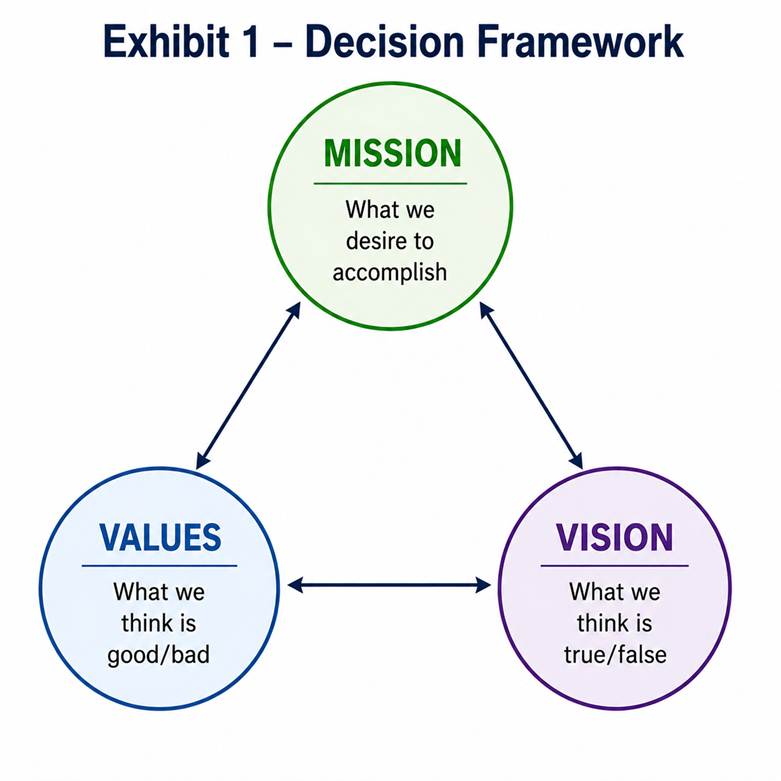
Most corporations and many other organizations formally adopt statements of mission, values and vision. Linking these concepts as I use them was a result of personal reflection. I imagine that there must be books written similarly linking these concepts to making decisions in organizational contexts. I will use them throughout my writing as present, though usually implicit and subconscious, in every individual. They merge in complex ways for groups of people.
For these to land, readers may best try them out for personal, government, societal or other decisions. How do our beliefs (vision) influence our decisions? Many beliefs are value-neutral; others carry strong moral weight. The same accepted facts may align positively with the convictions of one person while prompting outrage from another. How do those two people make decisions? Indeed, how might our values prompt us to look at entirely different aspects of the world? Do objectives sometimes seem to be selected ahead of time? Or are they informed and shaped by our values and evolving understanding?
The foregoing only samples the potential implications of the Decision Framework. It also provides language for making collective decisions. Can we emphasize shared values? Or when values do not align, can we agree on objectives? From my actuarial perspective: can we consider vision in a way that accepts absolute truth may exist, but our perception is along some range of certainty? I have case studies in mind but will leave them for future posts.
The Evolution of a Decision Framework
The parameters within a Decision Framework are not fixed; they evolve. This evolution is not always dramatic, but it can occur over time or through significant decisions.
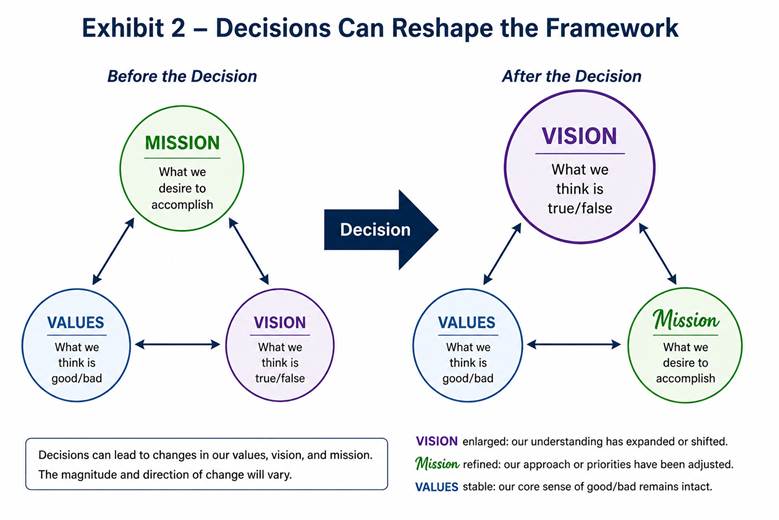
We make decisions based on understanding, ethics and what we want to accomplish. How we judge the outcome of our decisions will be based upon the parameters that informed the decision. The framework remains intact after most mundane decisions. But sometimes decisions, and their outcomes, can alter the framework for subsequent decisions. This is an illustration and not a roadmap for how the Decision Framework can evolve.
You’ve made a decision to read up to this point. Has reading this enlarged your understanding? Will it influence how you understand or apply my subsequent writing? I certainly hope so. I accept that some of the burden lies on me to carefully present my vision. Some readers may immediately see value in this. Others might do some work to figure out what this means to them. Many people – most in the world, though I hope fewer of my friends – will not be much inclined to read this at all or to allow it to influence future understanding or decisions.
Whichever group you find yourself in, thank you for visiting the esoteric side of my analysis.


Leave a comment