When I introduced Liberty Township fire levy revenues in per capita terms, I asked a rhetorical question:
“Is it a different cost to transport a person to the hospital from a home valued at $250 thousand than from a home valued at $1 million?”
If the answer is “No,” then per capita comparisons give us a better handle on how funding levels stack up across communities — especially when we’re trying to build a system that can keep up with real-world demands, not just tidy math on paper.
🔹 Key Points
- When measured per capita, passing the proposed levy would bring Liberty Township in line with the average of its peers.
- Rejecting the levy would leave the township at a steep disadvantage — especially relative to departments like Hilliard that are aggressively expanding.
The Traditional Measure: Per $100K Property Value
Most levy discussions center on cost per $100,000 of property value. It’s what appears on the ballot, and it’s the right tool for estimating your personal tax bill. But it’s not ideal for comparing the real-world capacity of different departments.
Take, for example, this communication from Washington Township (serving the City of Dublin) to promote renewal of their main fire/EMS levy:
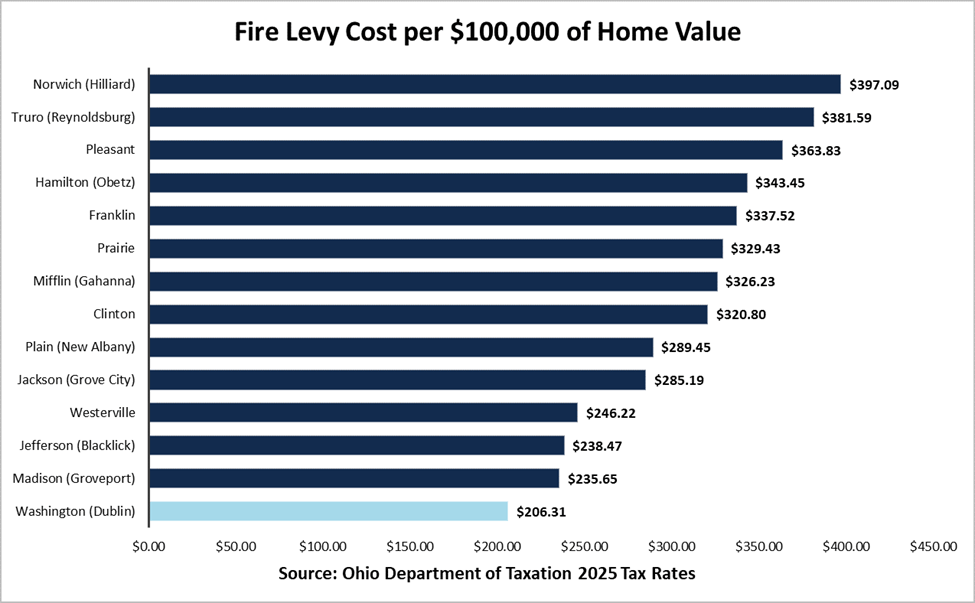
At first glance, it suggests Dublin has the lowest tax burden. But if homes in Dublin are worth more than in other areas — which they generally are — then a lower rate might still generate more revenue per person.
Why Include Dublin and Hilliard in Peer Comparisons?
Washington Township includes parts of Delaware County, making it relevant for Liberty comparisons. Meanwhile, Hilliard recently passed a substantial levy to open a fourth fire station and expand staffing. They’re directly competing for the same limited pool of qualified fire and EMS professionals — and putting pressure on Liberty Township’s ability to retain experienced staff.
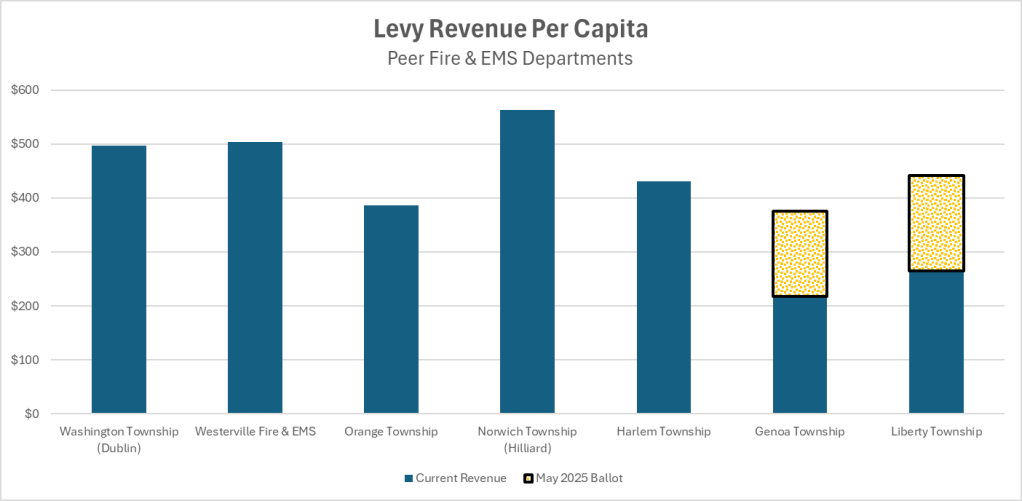
Liberty Township in Context: Per Capita Fire Revenue
Liberty Township’s effective fire millage is currently just 3.37, generating about $118 per $100,000 of property value. That’s far below what nearby communities collect. But what happens when we reframe the question using per capita revenue?
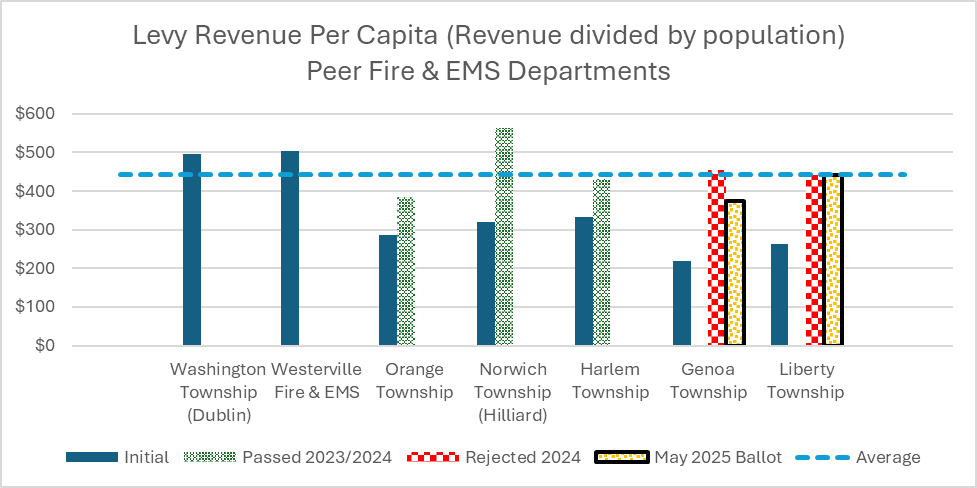
Several peers — including Hilliard, Harlem Township, and Orange Township — have passed new levies in the past two years. Genoa Township voters rejected a levy last November but are returning to the ballot this spring with a smaller request. Liberty Township didn’t follow Genoa’s approach of reducing the fire levy request, but it did take a different kind of step: scaling back its overall funding package. In total, the township is now asking voters for 2.4 mills this spring instead of the 4.4 mills proposed last November. That’s because the fire and EMS needs couldn’t wait. Funding requests for roads & bridges and parks & recreation were deferred — a clear signal that trustees see fire and EMS funding as urgent and essential.
In resilience terms, I think of this as triage. When resources are constrained and the system is under pressure, prioritizing the most critical functions — like public safety — is exactly what we hope our local leaders will do. It may not be ideal to delay other investments, but it’s a rational and adaptive response to current realities.
If Liberty voters approve the May levy, per capita revenues would rise to match those of comparable communities. If not, the gap will widen.

Concluding Remarks: Funding Resilience
Liberty Township leaders hadn’t been thinking in per capita terms when they proposed the new levy. That’s not a criticism — in fact, it makes the convergence across departments even more revealing. It suggests they’re all responding to real constraints in similar ways, even if we’re using different math to explain them.
But here’s the uncomfortable truth: rejecting the proposed levy would leave Liberty Township under-resourced in comparison to its peers, both now and as we grow. Resilience — in a community or a fire department — isn’t just about reacting in a crisis. It’s about maintaining capacity before one hits. That means funding systems at levels that can keep pace with change.
The world isn’t getting simpler. But that’s exactly why we need to be smarter — and maybe a little braver — in how we invest in the institutions we count on.
Addendum
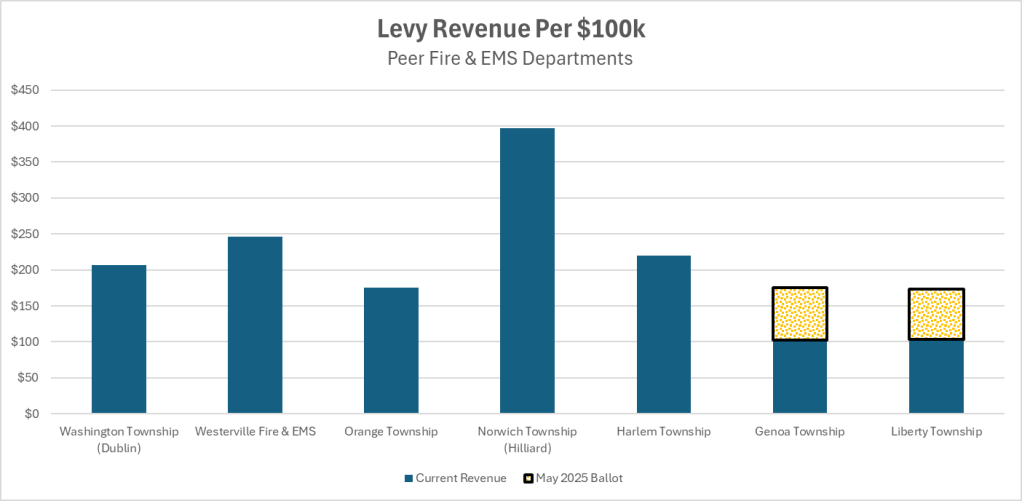
By request, here is additional information for the selected peer departments:

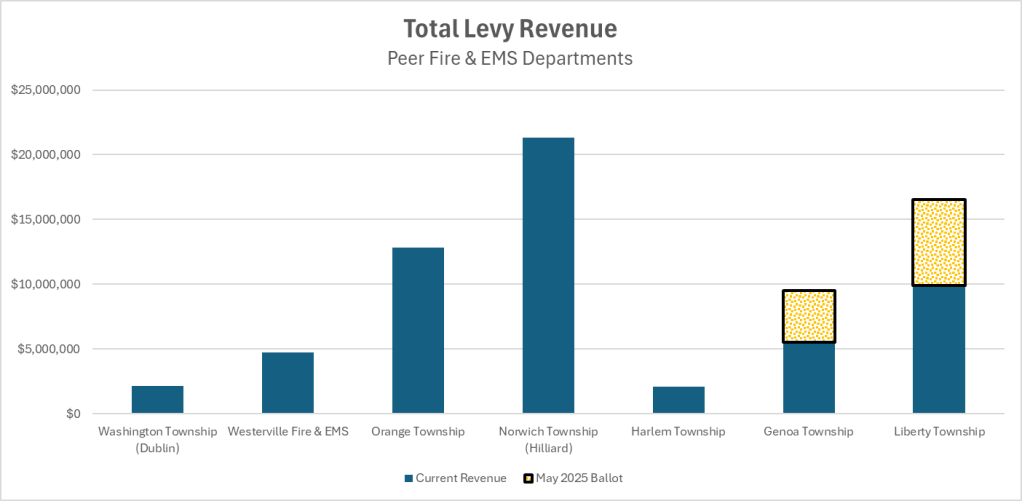
Per capita revenue doesn’t capture everything influencing fire and EMS funding needs. It overlooks factors like commercial or industrial property. So is it perfect? Of course not—no metric is. I suggest it because it’s simple, familiar, and useful for comparison. Still, I’m always open to better ideas—or to analysis that shows where and why per capita might fall short.
Regardless of how you scale it—per $100k of property value or per resident—Liberty and Genoa Townships stand out for collecting the least revenue. The proposed ballot measures in both districts are nearly identical on a per-$100k basis, but because Liberty has more high-value property, its levy would bring in slightly more revenue per resident.
Future posts will begin with per capita metrics and then build toward broader projections that incorporate total population to give a clearer big picture of what’s at stake.


Leave a Reply