All of my posts up to this point have focused on dollars and cents—revenues, expenses, and what it takes to fund emergency services in our township. But what are we actually paying for?
When you dial 911—unless it’s a police matter—it’s our Fire, Rescue & EMS personnel who show up. And in an emergency, you want two things:
- A fast response
- Ideally, someone from Liberty Township
I’ll explain that second point right away.
Why Does It Matter Which Ambulance Shows Up?
All publicly funded EMS departments in central Ohio follow the same basic billing approach. If you’re transported by your department—the one you pay taxes to—you don’t get a bill. Liberty Township practices what’s called soft billing: they bill your insurance for what it covers, and you’re not stuck with any deductible, copay, or coinsurance.
But if all Liberty Township ambulances are in use and a neighboring department responds, it’s a different story. You’ll wait longer—and you will get a bill for the ride to the hospital.
Growth in Staff with Growth in Population
As the township grows, staffing grows too—but not one-for-one with every new resident. Fire and EMS staffing increases are incremental, just like adding a fire truck, ambulance, or eventually, a station.
Incidentally, the fire chief shared with me that some residents in the north want a station sooner just while many residents want to reject the levy again. He can’t justify the cost—yet—based on current call volume, especially if he assumes (for argument’s sake) that township residents aren’t wildly enthusiastic about higher taxes. (That was a joke. Forgive me.)
Figure 1 shows how full-time staff has increased alongside population. The 2025 number includes additional hires made possible if the proposed levy passes.
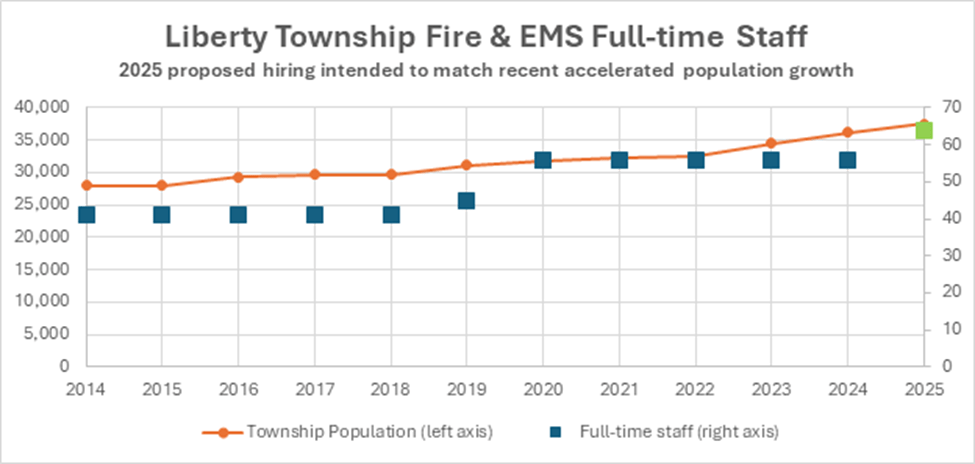
Fine print or key point? The staffing numbers don’t include part-time personnel. I’m not sure of all the specifics, and the chief likely can’t comment publicly on hypothetical cost-cutting. But it’s a fair bet that part-time staff would be the first to go in a budget crunch.
That sounds like a prudent cut—until you realize that part-time employment is the department’s recruiting pipeline. Many of today’s experienced staff came up through that system, and many are nearing retirement eligibility. Gutting part-time roles could undermine long-term staffing stability.
The chief also gave me a deep dive on target staffing levels. (He’s passionate. Try asking him—just make sure you have time.) His philosophy: staff enough to handle demand—but not so much that skills go unused. He’s not looking to overstaff. I believe him.
Mutual Aid: When Our Stations Are Empty
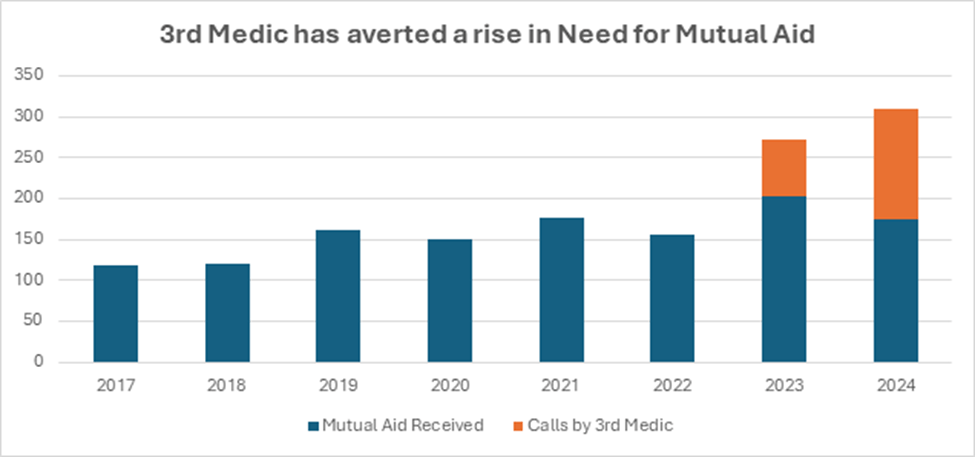
One key metric to watch is how often all on-duty staff are out on calls. When that happens, we rely on mutual aid—backup from nearby departments we have agreements with. But they prioritize their own residents first.
Figure 2 shows mutual aid received annually. These are calls where Liberty Township would have handled it—if we had more medics on duty. The township staffed a third medic in 2023 and 2024. It wasn’t staff all the time as they are already watching expenses given the funding uncertainty. The orange bars represent additional mutual aid calls that would have been made without the third medic at all. This is growth that the township has needed and will need to continue to handle our own emergency response.
Tail Events and the Actuarial Perspective
Liberty Township EMS responded to 2,328 calls in 2023. Fire and rescue? Another 1,113. These are everyday emergencies—the routine backbone of service that we fund through property taxes.
But as an actuary, I can’t help thinking about tail events—those rare-but-impactful scenarios that stretch systems beyond their limits. I had California wildfires and Hurricane Helene in mind when I planning this post. Those might seem far from central Ohio, but wildfire is now affecting places like New Jersey. Natural disasters can happen anywhere.
The time to have a well-staffed, well-funded emergency response system isn’t after disaster strikes.
Fragility, Resilience, and What Comes Next
I’ll be writing more about fragility and resilience once the levy vote is behind us.
Mature systems tend to conserve resources, sometimes to the point of brittleness. They don’t always break because something went wrong. Sometimes they break because they worked—and then became fragile.
I see this kind of fragility in many of the systems we argue about—on social media and beyond. I’ll explore those in future posts, especially how we manage differing perspectives, values and objectives when tackling national or global issues.
But when it comes to local emergency response—do we really disagree?
The real debate is usually over urgency—whether we can afford to wait, stretch, or skimp. I get it. If you’re struggling financially, you look for places to cut. A property tax levy might not be the first thing you’d vote down if you had your choice. But when it’s your only choice…
I respect that. Truly.
I just hope you’ll consider that fragile times aren’t when we want to dial down our emergency services.
Conclusion
Whatever the outcome of this levy vote, I’ll keep talking about resilience—because it’s not about insisting on one outcome. It’s about being ready to adapt if things don’t go our way.
If the levy fails, I’ll keep writing, speaking, and advocating. And maybe even pull some new ideas off the shelf that folks haven’t considered.
Most of the time, I live quietly in a safe community, surrounded by people I care about. That won’t change. But I do think this levy matters—a lot. I hope you’ll vote for it.
And wherever you land, I wish you well as we all navigate inflation and the many uncertainties of our time.
 Cultivated Resilience
Leave a comment