As a “fixed rate” levy, the Liberty Township fire levy generates additional revenue from new development but not from increases to property values. This post shows how that levy income has remained relatively stable when measured per capita — that is, per resident of the township.
This kind of pattern isn’t just a fiscal curiosity. It’s also a classic example of slow variables in community resilience. You’ll see what I mean by the end.
Key Points
- “Per capita” means “per person” — I divide fire levy revenue by population.
- Since 2014, revenue per person has stayed around $270.
- The current levy on the ballot doesn’t change the way we’re taxed — it’s still a property tax — but it helps restore purchasing power lost to inflation. While inflation isn’t the only factor behind the size of the proposed increase, it’s a key reason why Liberty Township and many peers have new levies on the ballot.
- This is a real-world example of a system that’s robust to population growth but fragile to inflation.
📌 Important Point:
Several people have asked whether this levy is charged per person. It’s not. Like the existing levy, it’s still a property tax calculated per $1,000 of assessed value. I’m just analyzing revenue per capita because it helps us understand how fire services scale (or don’t) with a growing population and changing costs.
Why Per Capita Makes Sense
Is it a different cost to transport someone to the hospital from a $250,000 house than from a $1 million house? That’s a rhetorical question.
It makes more sense to track fire and EMS costs per person than per dollar of real estate. That’s why per capita is often used in comparisons between communities or in budget trend analysis.
Here’s the formula I use:
Per capita fire levy revenue =
Annual fire levy revenue ÷ Estimated Liberty Township population
Per capita is not necessarily a perfect metric. For example, commercial development brings in added revenue while the incremental need for services varies by type of business. Per capita serves as a good overall measure for both increases to revenue and for needed services. I’m always happy to consider caveats and alternate metrics.
Per Capita Revenue in Liberty Township

The township is growing fast — especially in the past couple of years. More people mean more calls to fire and EMS. Fortunately, because the fire levy is based on a fixed rate, revenue increases with population growth.
But not with inflation.
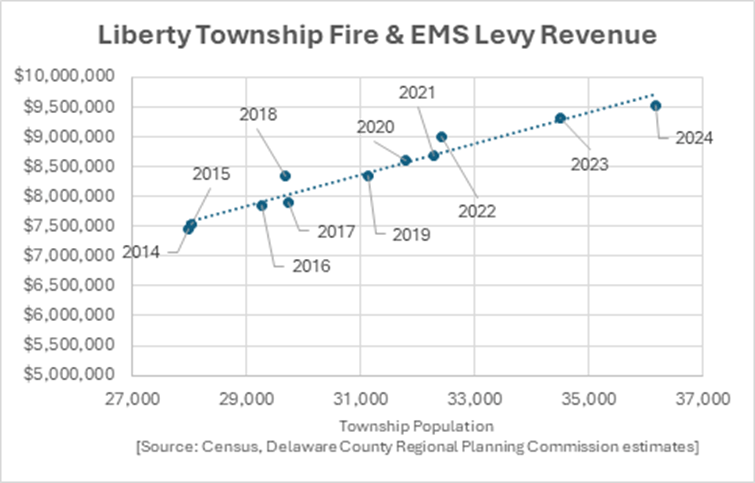
That steady growth lines up closely with population increases. So far, so good.

Here’s the tension: while revenue per person has stayed level, costs haven’t. The dashed line shows what the 2014 amount would look like if it had grown with the Consumer Price Index (CPI). That gap — especially visible in 2024 — is why there’s a levy on the ballot.
A Resilience Perspective
Let’s zoom out for a second.
In resilience science — especially the adaptive cycle — we talk about slow variables that shape a system’s long-term behavior. Fixed-rate levies are a great example: they’re slow to change by design, which helps protect against short-term volatility but can create blind spots when conditions shift rapidly.
Liberty Township’s fire levy system has been robust to population growth — it scaled with demand.
But it’s fragile to rapid inflation. That kind of fragility isn’t a moral failing or a political problem — it’s a design constraint. Recognizing it is the first step toward adaptation.
This is exactly what the fire department — and voters — are now trying to do.
Concluding Thoughts
The per capita numbers confirm what residents and department staff already feel: costs have risen, but revenue growth hasn’t kept up. The levy currently on the ballot doesn’t overhaul the system — it’s a standard fixed-rate property tax — but it’s designed to restore purchasing power lost to inflation.
In a growing and changing township, resilience means adapting deliberately. Understanding these mechanics is part of that.
If you’ve got questions about this data — or if you want to geek out about adaptive cycles and municipal finance — I’m here for it.
 Cultivated Resilience
Leave a comment