I’ve meant to start a blog for a while now. So why now?
Because there’s a fire levy on the ballot in my township (about 38,000 people, central Ohio), and I need a place to share analysis, research, and perspective — especially as someone advocating a vote FOR the levy. But this isn’t just about one levy. It’s part of a bigger theme that’s become central to how I think about the world:
We can only build resilience by first understanding not just the facts, but the perspectives of others — and then using that understanding to influence outcomes.
That’s the spirit of this blog. Sometimes I’ll dive into very big ideas — national, global, even philosophically existential. But I’ll circle back to what we can actually do about them, especially close to home. I hope some readers will join me in this ongoing experiment in curiosity and pragmatism.
If You’re in the Mood for Existential Philosophy Dressed as Fiction…
Check out my short story “What Could Possibly Go Wrong”, submitted to the Society of Actuaries’ Speculative Fiction Contest:
Speculative Fiction Contest & Art Expo | SOA
If you like it, please consider voting for it!
Who Am I?
This sounds like a deeply existential question. I may get there eventually — but for now, here’s the mundane version:
- Actuary: I do numbers. Math. Data. Risk. Analysis. Over time, that’s turned into something deeper: a philosophy of how to make decisions when faced with uncertainty.
- Intellectually agnostic: Raised with religious certainty, I later wandered into secular dogmas before realizing that I’m now more interested in exploring than arriving. When I say I’m intellectually agnostic, I mean I actively try to see beyond my own lens.
- Husband, father, community member: I was widowed young, raising kids just as smartphones and social media were exploding. Now remarried, that journey shapes how I think about adaptation, community, and resilience.
Why Start This Blog?
Aside from the immediate need to write about the fire levy, I’ve long worked in a professional space that models financial systems. I project financial asset prices decades into the future. That work blurs actuarial analysis into macroeconomics — and eventually, philosophy. What do we consider beyond the quantities? Big questions about uncertainty, systems, and society inevitably follow.
Resilience
One of the central models I draw from is the Adaptive Cycle, visualized below. It’s from Panarchy: Understanding Transformations in Human and Natural Systems. (Highly recommend the book if you’re into systems thinking.)
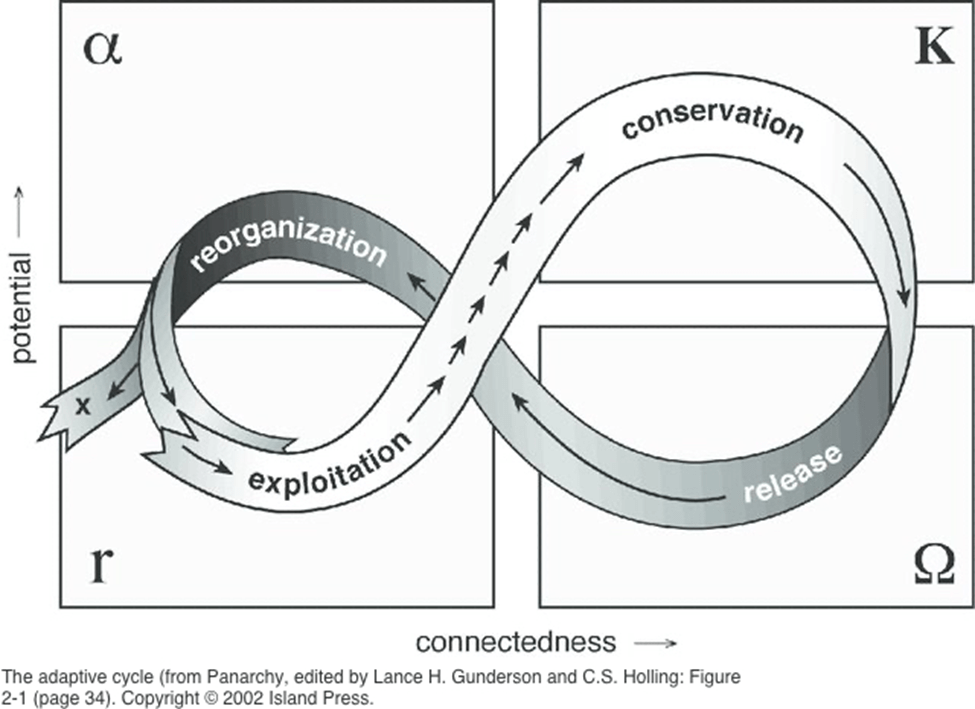
The Adaptive Cycle shows how systems — from ecosystems to economies to institutions — go through phases: exploitation, conservation, release, and reorganization. Along the way on the conservation phase, they become more connected and more fragile eventually leading to collapse and release.
It’s tempting to try to engineer our way out of fragility. To stabilize. To fix things. But those attempts can sometimes create the fragility leading to the next collapse.
I don’t reject large-scale solutions entirely. For sure, I will analyze to understand those issues. But I believe resilience is most realistically fostered at levels we can truly engage with: individual, family, and community.
Why “Cultivated Resilience”?
Because I think the right metaphor lies between the chaos of the jungle and the rigidity of engineering.
- The jungle represents wild, untamed cycles.
- Engineering represents our attempts to impose order — technologically, socially, economically.
But maybe what we need is something in the middle: cultivation.

Cultivation is structured, but organic. It allows growth, pruning, and adaptation — without pretending we can fully control the outcome.
Where this is going
Let’s be honest: my thinking will meander.
I hope to write a book eventually — I even have a table of contents. But I’m not always sure how (or whether) the pieces connect. That’s part of the experiment here: short essays that can stand alone but gradually reveal a bigger picture.
Some posts will focus on local issues. Others will explore abstract systems and philosophy. But they all come back to this:
How can we make sense of a fragile world — and what can we do about it, starting right where we are?
And finally, while the ideas run deep, I try not to take myself too seriously. I’ll pepper in occasional humor. Fair warning, it may look like this.

Thanks for reading. Let’s see where this goes.
 Cultivated Resilience
Leave a comment